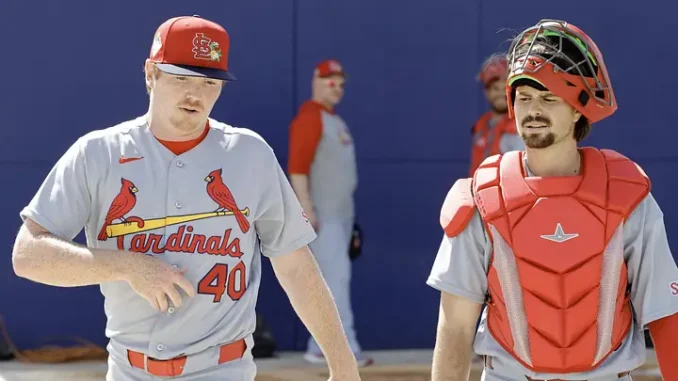
There’s something uniquely intriguing about this particular trade deadline for the St. Louis Cardinals. In many ways, it feels like a transitional moment for the organization.
While Chaim Bloom may have had some level of involvement in prior decision-making, this is widely viewed as his first true opportunity to shape a deadline strategy as the lead voice. That alone makes the situation compelling. It’s not just about what moves get made—it’s about what those moves say regarding the philosophical direction of the franchise moving forward.
More specifically, this deadline might serve as an early indicator of how the Cardinals intend to operate under Bloom compared to the previous era led by John Mozeliak. The contrast I’m interested in isn’t necessarily about the caliber of players they acquire in return packages. Instead, it’s about the type of players they’re willing to move. That distinction matters, because it reflects how aggressive—or conservative—the front office is prepared to be when it comes to reshaping the roster.
At the time of writing this, late on a Sunday evening, the Cardinals had yet to make any moves. By the time this piece is published—or by the time you’re reading it—that may no longer be the case. Still, the absence of early activity creates a certain expectation. When teams remain quiet deep into deadline day, it often signals a more conservative approach. In this scenario, it wouldn’t be surprising if the Cardinals ultimately settle into the least eventful version of a trade deadline: moving only expiring contracts while leaving the rest of the roster intact.
BREAKING: Mets-White Sox Confirmed Another Blockbuster Deal
That possibility feels increasingly likely the longer the silence continues. And while that type of approach isn’t necessarily wrong, it does limit the opportunity for meaningful organizational change. A quiet deadline tends to preserve the status quo, whereas bold decisions can accelerate a team’s long-term trajectory.
This idea was reinforced during a recent podcast discussion when I was asked which team I would most like to see a Cardinals player traded to. The question itself didn’t resonate much with me—I don’t particularly care where players end up. However, my answer unintentionally revealed something about my mindset. I mentioned Riley O’Brien potentially landing with the White Sox, not because of any specific fit, but because the act of trading him would likely indicate a strong return.
That’s really the core of it. I find myself rooting for scenarios where players who aren’t obvious trade candidates end up being moved. Not because I want them gone, but because it suggests the Cardinals received an offer that met—or exceeded—their valuation. That’s a fundamentally different dynamic compared to trading players on expiring deals, where leverage is limited and returns are often modest.
This brings me to Andre Pallante. When I suggest that the Cardinals should consider trading him, it’s important to clarify the context. This isn’t a critique of Pallante as a pitcher. Rather, it’s an acknowledgment of where he stands in terms of value, trajectory, and organizational fit.

Pallante profiles as a pitcher with a relatively limited ceiling. He’s effective, but not dominant. His skill set—heavy on ground balls and contact management—can be valuable, but it doesn’t typically translate into elite upside. Metrics over time have reflected that profile, with moderate strikeout rates and reliance on inducing weak contact rather than overpowering hitters . That type of pitcher can absolutely hold a role in a rotation, but it’s not the kind of profile teams usually build around long-term.
BREAKING: Cardinals All-Star Sends Teammate Perfect Goodbye After Trade
At the same time, Pallante’s salary is beginning to rise through arbitration, and his value may never be higher than it is right now. He’s under team control for two additional seasons beyond the current one, which makes him attractive to potential buyers. However, from the Cardinals’ perspective, the question is whether he fits into their long-term plans.
Ideally, by the time Pallante reaches free agency, the organization will have developed or acquired higher-upside arms to fill those rotation spots. If that’s the expectation—and it should be—then holding onto him may not align with the bigger picture. Trading him now, while his value is strong, could yield assets that better match the team’s future needs.
Of course, there are uncertainties. It’s not entirely clear whether Pallante is even being actively shopped. It’s also possible that the market for him isn’t particularly robust. Pitchers with his profile don’t always generate significant demand, especially if teams view them as back-end options rather than impact starters.
Still, if we assume there is a market, the logic for moving him becomes clearer.
From a roster construction standpoint, the Cardinals appear to have sufficient depth to absorb his departure. Young pitchers like Hunter Dobbins and Quinn Mathews are pushing for rotation spots, and there are others in the system who could contribute in the near future. Even if it requires some creativity—such as experimenting with different arms or temporarily stretching depth—it’s a manageable transition.

Looking ahead to next season, the team could further reinforce its rotation through free agency. Whether that means pursuing a top-tier starter or signing a short-term reclamation project, the financial flexibility exists to make additions. Meanwhile, several prospects in the upper minors could be ready to contribute by midseason, creating even more internal options.
That combination of current depth and future upside strengthens the case for capitalizing on Pallante’s trade value now.
JUST IN: Phillies trade land Blue Jays’ $10.75M Gold Glove outfielder
Financially, he represents an appealing asset. His current salary is modest—around $4 million—and even with projected increases through arbitration, he remains cost-effective relative to his production . Over the next few years, he’s expected to deliver solid value at a below-market rate, which is exactly the type of player contending teams seek at the deadline.
In terms of performance, Pallante has taken steps forward this season. He’s posted improved results, including a mid-3.00 ERA and positive contributions in terms of wins above replacement . That improvement enhances his appeal and reinforces the idea that this might be the optimal time to move him.
When you factor in his projected production and salary, he offers meaningful surplus value. That doesn’t necessarily translate into a blockbuster return, but it should be enough to command legitimate prospects—potentially players just outside top-100 rankings or those with solid future value grades.

Now, it’s worth acknowledging that deadline trades don’t always follow clean valuation models. Prices can fluctuate based on demand, timing, and playoff implications. In Pallante’s case, he may not be viewed as a difference-maker for a postseason run, which could limit the premium teams are willing to pay. Even so, his years of control still provide inherent value.
BREAKING: Angels Confirmed 3-Player Blockbuster Deal as Trade Deadline Looms
If the Cardinals receive an offer that exceeds expectations, the decision becomes straightforward. If the offers align closely with projected value, it becomes more nuanced. But one thing seems clear: it’s difficult to envision a scenario where Pallante’s trade value increases significantly beyond this point.
Shifting to Lars Nootbaar, the calculus is somewhat different. As an outfielder with a more dynamic skill set, his value is tied not only to production but also to perception. He’s shown the ability to contribute offensively and defensively, though injuries and inconsistency have impacted his overall output in recent seasons .
Estimating his trade value involves projecting both his current contributions and future potential. Based on typical performance metrics, he profiles as an average to slightly above-average player. That level of production, combined with manageable salary commitments, gives him moderate trade value.
However, there’s an argument to be made for holding onto him—at least for now. If Nootbaar performs well over the final stretch of the season, his value could increase heading into the offseason. A strong finish would allow the Cardinals to market him as a more impactful piece, potentially generating better offers.
On the other hand, if the team believes his current value is close to its peak—or if they receive a compelling offer—trading him now could make sense. Unlike Pallante, whose case is driven largely by timing and roster construction, Nootbaar’s situation is more dependent on market dynamics and performance trends.
BREAKING: Angels land surprising trade with Rangers
Ultimately, the decisions surrounding both players will say a lot about how the Cardinals are approaching this transition period. Moving Pallante would signal a willingness to act proactively, leveraging value before it declines. Trading Nootbaar would suggest a broader openness to reshaping the roster, even if it means parting with a fan favorite.
And that last point shouldn’t be overlooked. Nootbaar has become a popular figure among fans, and ownership considerations can sometimes influence decisions in subtle ways. While front offices typically operate with long-term goals in mind, there are instances where sentiment and marketability play a role.
It’s impossible to know exactly how much influence ownership exerts in these situations. Some owners are more visible in their involvement, while others operate behind the scenes. But it’s reasonable to consider the possibility that certain players carry added weight beyond their on-field value.
As the deadline unfolds, the Cardinals have multiple paths they can take. They can opt for a conservative approach, dealing only expiring contracts and maintaining continuity. They can take a more aggressive stance, moving players like Pallante to maximize long-term value. Or they can strike a balance somewhere in between.
Whatever direction they choose, this deadline represents more than just a series of transactions. It’s a glimpse into the organization’s evolving identity—and a test of how willing they are to embrace change.



Be the first to comment