Royals roster flexibility move. The Kansas City Royals have spent multiple offseasons trying to remedy one persistent organizational weakness: the outfield. For several years, the club has struggled to generate anything close to league-average production from its outfielders, and each winter has brought renewed attempts—often unsuccessful—to fix that deficiency.
This offseason, the situation is especially delicate. Kansas City appears to be working within a tight financial structure but simultaneously possesses one of the deeper starting rotations in the league. That combination has fueled widespread industry speculation that the Royals might ultimately leverage their pitching depth to acquire the outfield help they desperately need.
Royals president of baseball operations J.J. Picollo touched on this reality in an interview with Alex Speier of The Boston Globe. Picollo acknowledged that many teams are aggressively pursuing starting pitching, an area where Kansas City happens to enjoy surplus options.
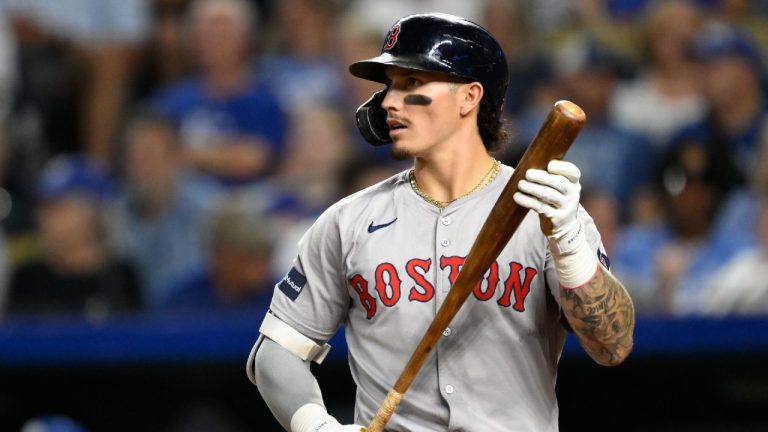
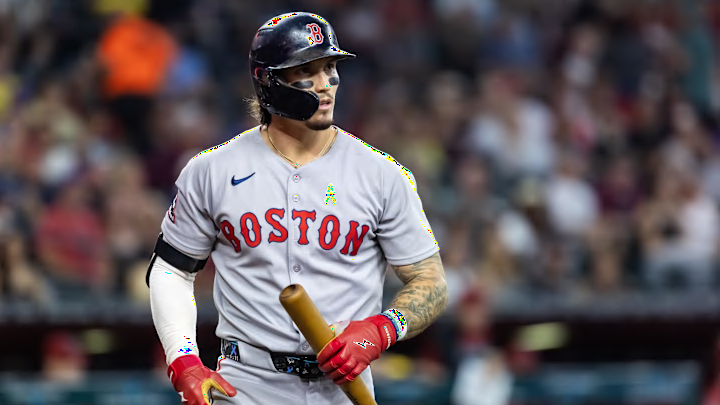
As he explained it, if a club with outfield talent is also seeking rotation upgrades, the conditions could be ripe for a mutually beneficial trade. Speier also reported that before this year’s trade deadline, the Royals had shown interest in Red Sox outfielder Jarren Duran—a hint that Kansas City has been actively monitoring potential fits for some time.

Kansas City’s need for outfield improvement is rooted in long-term underperformance. The team has not fielded an outfield group capable of consistently contributing since before its 2015 World Series championship run. Last offseason, the Royals were connected to free agents such as Anthony Santander and Jurickson Profar, but nothing materialized.
The issue grew even more glaring in 2025, as Royals outfielders combined for a dismal .225/.285/.348 slash line. Their production translated to a 73 wRC+, meaning they were 27% below league average—dead last among all MLB outfield units. In a season when the club took meaningful steps forward in the rotation and bullpen, this lack of outfield offense was an anchor that dragged down the entire lineup.
Given these factors, the Royals’ front office has turned its attention to the trade market. Budget restrictions make a splashy free-agent signing improbable. Back in October, owner John Sherman publicly suggested that the organization was unlikely to increase payroll in 2026. Current projections have next year’s payroll at roughly $139 million—already slightly higher than the $138 million spent at the conclusion of 2025. With so little breathing room, the club has to be strategic.
The free-agent landscape further complicates their options. The top of this winter’s outfield market includes names like Kyle Tucker and Cody Bellinger—players expected to command major long-term contracts, which Kansas City cannot realistically pursue. After those elite options, the talent level dips considerably to veterans such as Mike Yastrzemski and Harrison Bader.
The Royals roster flexibility move traded for Yastrzemski at the deadline, and he performed well in a short sample, but he is entering his age-35 season and may require an eight-figure deal. That combination of age and cost raises questions about whether he fits what Kansas City needs: youthful, controllable upside rather than short-term stopgaps.
All of this points back to the possibility of trading from the rotation. MLBTR’s Nick Deeds recently examined the same scenario, noting that Kansas City has more starting pitchers than available rotation spots. Their current group includes Michael Wacha, Seth Lugo, Cole Ragans, Kris Bubic, Noah Cameron, Bailey Falter, Ryan Bergert, Stephen Kolek, Luinder Avila, and Ben Kudrna. With only five rotation slots, the surplus is clear.

However, pulling off a trade is not straightforward. Wacha and Lugo are unlikely candidates, as both have signed extensions in the past year and appear central to the club’s short-term stability. Bubic has drawn interest elsewhere, but his value is diminished. With only one year of team control remaining and coming off a late-season rotator cuff injury in 2025, teams may view him as more of a mid-level acquisition than a centerpiece.
That leaves Cole Ragans as the most logical—and simultaneously the most complicated—trade candidate. On the one hand, Ragans possesses the elite ceiling that would draw an enormous return. After a breakout 2024 season in which he finished fourth in American League Cy Young voting with a 3.14 ERA across 186⅓ innings, he established himself as the kind of top-of-the-rotation arm front offices covet. But his 2025 campaign was marred by groin and shoulder issues, limiting him to just 13 starts and inflating his ERA to 4.67. Trading him now would mean selling at a relative low point compared to the value he held just a year earlier.
Ragans remains extremely affordable and controllable, which further complicates the idea of dealing him. He is already under contract for $4.5 million in 2026 and $7.5 million in 2027, with arbitration eligibility in 2028. For a small-market club like the Royals, that kind of cost-certainty for a potential ace is gold. Unsurprisingly, Picollo has indicated that while no pitcher is completely untouchable, one specific starter—widely assumed to be Ragans—would require a significant return to pry away.
Kansas City could instead attempt to move pitchers such as Cameron, Bergert, Kolek, Avila, or Kudrna. Yet none of those names offer the upside that Ragans does, and though they are in their pre-arb years, they profile more as depth options or back-end pieces than immediate rotation anchors. A club looking to make a major upgrade would likely look elsewhere unless packaged creatively.
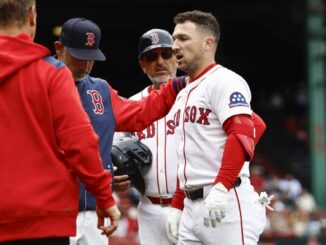
Enter the Boston Red Sox, a team that fits naturally with Kansas City’s situation. Boston’s roster features an abundance of outfielders but remains in search of pitching. Their current outfield depth chart includes Jarren Duran, Ceddanne Rafaela, Roman Anthony, Wilyer Abreu, and Masataka Yoshida, with top prospect Jhostynxon García nearing readiness. For more than a year, trade rumors have swirled around this group.
Not every Boston outfielder is a viable trade chip. Anthony and Rafaela have already inked long-term extensions and are essentially off the market. Yoshida, despite his offensive upside, carries negative value due to defensive limitations and a contract that outweighs his production. That leaves Duran and Abreu as the most logical pieces to consider. Both are left-handed hitters and strong defenders, with notable platoon splits that create redundancy within Boston’s roster.

Contractually, there are differences. Abreu still has four seasons of club control and will not reach arbitration until next winter. Duran, however, qualified as a Super Two player, giving him four arbitration years instead of three. He earned $3.85 million in 2025 and is projected to make $7.75 million plus bonuses in 2026. With the Red Sox operating under financial constraints this offseason, moving Duran could free up valuable payroll space while returning the pitching help they need.
Duran’s performance since 2024 makes him especially appealing. Over the last two seasons, he has posted a .271/.337/.468 slash line, good for a 121 wRC+. During that stretch, he has racked up 58 stolen bases and graded out as an excellent defender. FanGraphs credits him with 10.8 wins above replacement in that two-year span—production that would instantly elevate the Royals’ outfield from worst in baseball to something far closer to competitive.
Kansas City’s current outfield picture remains unsettled. Jac Caglianone is likely to receive another opportunity after struggling in his 2025 debut. Kyle Isbel appears to be the leading center-field option, largely due to his defensive prowess. Duran has plenty of experience in center field but has recently played more left field in Boston due to Rafaela’s elite glove. Depth options such as Drew Waters, Kameron Misner, John Rave, and Dairon Blanco remain on the roster but, in an ideal world, would fill reserve or situational roles.

Boston, meanwhile, has already taken one major step toward improving its rotation by trading for Sonny Gray. He now joins Garrett Crochet and Brayan Bello atop the staff. Two rotation spots remain open, with potential candidates including Kutter Crawford, Patrick Sandoval, Payton Tolle, Connelly Early, Kyle Harrison, and others. Crawford and Sandoval both spent significant time on the injured list in 2025, introducing uncertainty, while the younger options are still working to establish themselves as consistent major-league contributors.
Although reports suggest Boston is focusing more on upgrading its lineup following the Gray acquisition, that does not rule out additional pitching moves—especially if they can move from an area of surplus. A framework around Duran-for-pitching could help both franchises, but such a deal would be just one of many possibilities. If the Royals do decide to make Ragans available, they would engage with numerous clubs beyond Boston. Likewise, if the Red Sox make Duran available, they would draw strong leaguewide interest.
Whether these two organizations ultimately align remains to be seen, but given the needs, surplus, and potential motivations on both sides, the possibility remains one of the more intriguing trade scenarios of the offseason.
MORE MLB NEWS:
-
Mets’ 3-Team Blockbuster Trade Nab Intriguing $31 Million All-Star Pitcher
-
Mariners to land 56-HR third baseman as replacement for Eugenio Suarez
-
Breaking: Cardinals’ superstar officially pushing toward surprising offseason move after problematic relationship
-
Breaking: Angels Officially Discussing Buyout Contract With Superstar Baseman
-
Understand Braves’ $73 Million All-Star Catcher Tabbed as Top Departure
-
Red Sox Reportedly Upgrade Superstar Infielder Alex Bregman To $155 Million Deal After Strong and Resilient Campaign

Be the first to comment