
The Boston Red Sox entered last weekend facing a wave of frustration after learning that third baseman Alex Bregman would not be returning to Fenway Park. The organization had hoped to retain the veteran infielder after he elected free agency at the conclusion of last season, viewing him as a stabilizing presence and a cornerstone for the lineup moving forward. Internally, the reaction was described as a moment of “real disappointment,” a reflection of how invested the club had been in keeping Bregman in Boston.
Those feelings were understandable given the financial commitment the Red Sox were prepared to make. Boston reportedly put a five-year, $165 million contract on the table, a strong offer that underscored how highly the front office valued Bregman’s blend of production, experience, and leadership.
Ultimately, however, the proposal fell short. Bregman chose to take a slightly richer deal elsewhere, agreeing to a five-year, $175 million contract with the Chicago Cubs, effectively closing the door on a potential reunion with the Red Sox before it ever fully opened.
While losing out on a player of Bregman’s caliber can be deflating, the Red Sox did not allow that disappointment to linger. Almost immediately, the organization pivoted from reaction to action. Rather than dwelling on what might have been, Boston’s baseball operations department moved swiftly to reassess its priorities and identify alternative ways to strengthen the infield, both at the major league level and within the farm system. The quick turnaround signaled a renewed sense of urgency and adaptability, traits the front office has emphasized as it looks to reestablish the club as a consistent contender.
MORE: White Sox lose top infielder to Cubs
Leading that response was chief baseball officer Craig Breslow, who has made it clear that setbacks in free agency will not derail the broader vision for the organization. Breslow and his staff began exploring multiple avenues for improvement, recognizing that roster construction is not solely dependent on landing one marquee free agent. Instead, the Red Sox have increasingly adopted a layered approach—balancing short-term competitiveness with long-term sustainability.
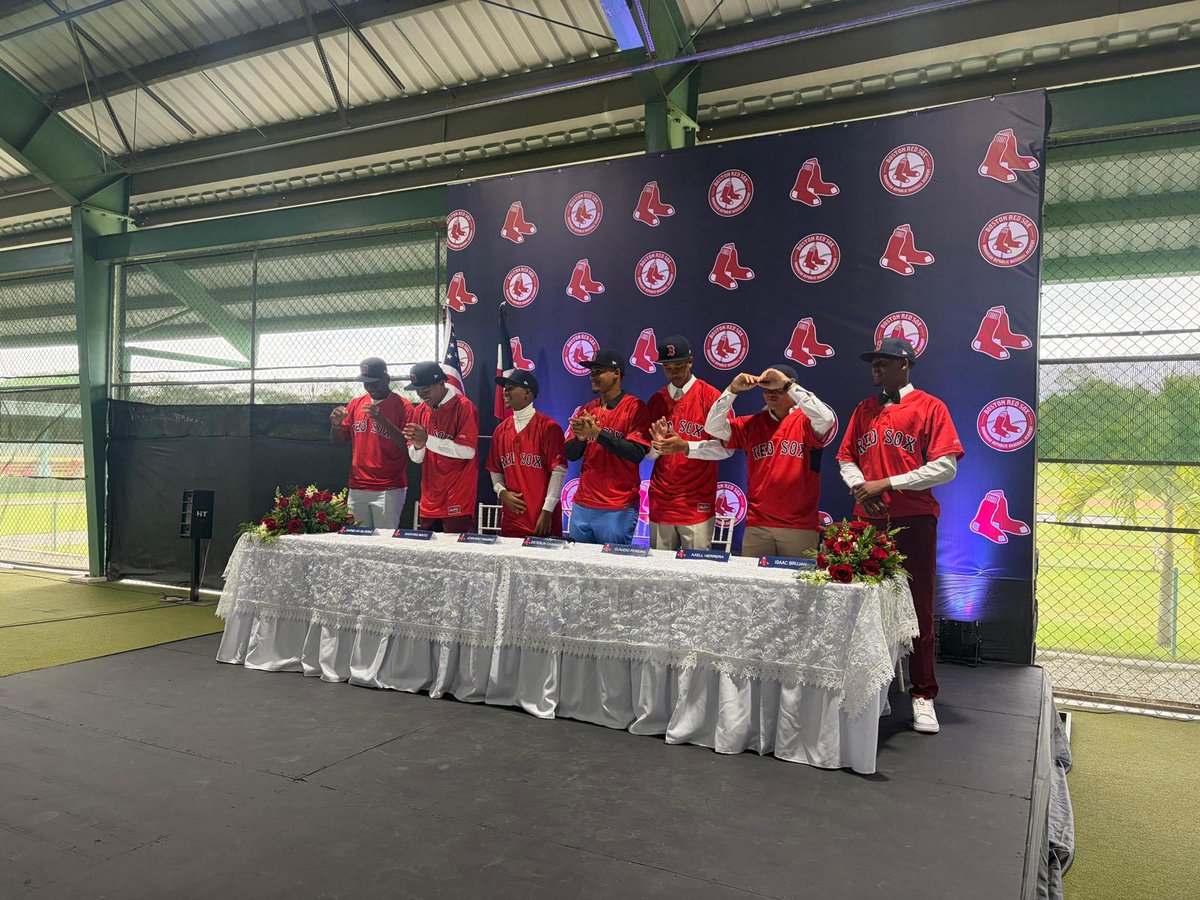
That philosophy was evident not only in conversations surrounding potential big-league additions, but also in a notable move on the international scouting front. On Thursday, according to the club’s official transactions ledger, the Red Sox finalized an agreement with one of the top amateur talents available on the global market.
The signing involved the 28th-ranked international prospect in the 2026 class, as evaluated by MLB Pipeline, highlighting Boston’s commitment to investing in future impact players even as it navigates present-day roster questions.
The deal brings a 17-year-old shortstop into the Red Sox system, with the young infielder receiving a signing bonus of $1.2 million. For Boston, the acquisition represents more than just another name added to the prospect list.
It reflects a strategic effort to replenish and deepen organizational depth up the middle, an area that often proves critical to long-term success. By targeting a highly regarded shortstop at such a young age, the Red Sox are betting on upside, development, and the possibility of molding a future everyday contributor from within.
This move also underscores how the club views player development as a vital complement to free-agent spending. While missing out on Bregman was undeniably a blow, Boston’s response suggests that the front office is determined not to overreact or compromise its long-range plans. Instead of scrambling for a lesser short-term replacement, the Red Sox appear focused on making calculated decisions that can pay dividends down the road.
MORE: White Sox to Land Dodgers All-Star Outfielder
In many ways, the sequence of events illustrates the delicate balance modern front offices must strike. Free agency can be unpredictable, even when teams are willing to commit significant resources. Players have options, leverage, and personal preferences that can quickly alter expected outcomes. The Red Sox experienced that reality firsthand with Bregman’s decision, but their swift pivot demonstrates an understanding that success is rarely built on a single transaction.
As the offseason continues, Boston’s infield picture remains a work in progress. There may still be moves to come at the major league level, whether through trades, short-term signings, or internal promotions. At the same time, the addition of a highly ranked international prospect reinforces the organization’s belief in building a strong pipeline of talent that can support sustained competitiveness.
Ultimately, while the disappointment surrounding Bregman’s departure was real, it has not defined the Red Sox’s offseason. Instead, it has served as a catalyst—prompting decisive action, reinforcing organizational priorities, and reminding everyone involved that progress often comes from how a team responds to adversity rather than the setback itself.
New Red Sox Signing Called ‘Uber Athletic’
The organization’s most notable addition among its latest international signings is shortstop Dawvris Brito, a highly regarded young infielder from Santo Domingo, a city long recognized as one of the most fertile talent pipelines in the sport.
Brito’s signing bonus, first reported by SoxProspects.com, ranked as the second-largest investment the Boston Red Sox made among the 18 international amateur free agents they officially signed on Thursday. That alone speaks volumes about how strongly the organization believes in Brito’s upside and long-term potential.
While Brito’s bonus was substantial, it was narrowly surpassed by the deal given to fellow Dominican prospect Garielvin Silverio, an outfielder who received a $1.4 million signing bonus—the largest issued by Boston in this particular international class.
Still, Brito’s payout represented a significant portion of the Red Sox’s overall spending capacity. Nearly one-quarter of the team’s $5.94 million international bonus pool was allocated to the teenage shortstop, a clear indication that the front office viewed him as a priority target rather than a speculative lottery ticket.

Such a commitment reflects confidence not only in Brito’s current skill set but also in his projected growth. Under the leadership of chief baseball officer Craig Breslow, Boston has emphasized investing in athletic, high-ceiling players with strong developmental traits, and Brito appears to check every one of those boxes. At 6-foot and 180 pounds, he already possesses a well-proportioned frame that scouts believe will continue to add strength as he matures physically.
MORE: Braves to Sign $61 Million Red Sox’s Pitcher
Evaluators across the industry have echoed Boston’s optimism. MLB Pipeline, one of the most widely respected scouting outlets in the game, has been particularly enthusiastic in its assessment of Brito. In its report, Pipeline described him as “an uber-athletic player” whose overall performance has taken noticeable strides in recent years. That improvement has not been limited to one area of his game, but rather has shown up across the board, from his defensive actions to his offensive consistency.
Defensively, Brito’s athleticism stands out. His quick first step, fluid footwork, and natural coordination give him a strong chance to remain at shortstop as he climbs the minor-league ladder. Those traits are especially valuable in today’s game, where teams place an increasing premium on middle infielders who can contribute on both sides of the ball. While it remains early in his professional journey, Brito’s defensive foundation provides a level of reassurance that his bat will not need to carry his entire profile.
Offensively, the early indicators are just as encouraging. According to MLB Pipeline, Brito is a right-handed hitter who has consistently produced eye-catching exit velocities during recent evaluations.
Reports note that he has regularly registered triple-digit exit velocity readings over the past year, an impressive feat for a player his age. Those metrics suggest not only raw power potential but also advanced bat speed and the ability to square up the baseball with authority.
Perhaps most intriguing is the sense that Brito is only beginning to tap into that power. As his body continues to mature and his frame fills out, scouts expect his strength to translate more frequently into game action. For now, the power is more projection than finished product, but the underlying data supports the belief that extra-base impact will come with time and refinement.

Beyond the measurable tools, Brito has earned praise for his work ethic and adaptability. The steady improvement noted by evaluators hints at a player who responds well to instruction and embraces the developmental process. For an organization like Boston, which places a strong emphasis on player development infrastructure, that trait can be just as important as raw talent.
MORE: Mets push for Yankees’ outfielder after Kyle Tucker whiff
When viewed in the broader context of the Red Sox’s international signing class, Brito stands out as one of the cornerstones of the group. While Silverio may have commanded the largest bonus, Brito’s combination of athleticism, defensive value, and emerging offensive upside makes him one of the most intriguing long-term bets in the system. The financial commitment underscores that belief, signaling that the organization sees him as a potential impact player rather than a depth addition.
Ultimately, Brito’s signing represents a calculated investment in projection and potential. The Red Sox are betting that his physical tools, combined with continued development, will justify the sizable share of their international bonus pool devoted to him.
If the scouting reports prove accurate, Brito could one day emerge as one of the more successful international signings from this class—a player whose early promise in Santo Domingo evolves into meaningful contributions at the highest level of the game.
Potential 5-Tool Player
Scouts who evaluated Brito have come away impressed by the raw tools and athletic traits he already displays at such a young age. Observers from Baseball America, in particular, highlighted the qualities that immediately separate him from many of his peers.

They noted that Brito stands out because of his “quick-twitch athleticism,” a phrase often reserved for players whose movements are sharp, explosive, and instinctive. This type of athletic profile suggests a player who can react quickly to the speed of the game and adapt as competition intensifies.
MORE: Padres officially land another minor-league deal
According to Baseball America’s assessment, that twitchy athleticism is most evident when Brito steps into the batter’s box. His natural explosiveness translates directly into impressive bat speed, allowing him to drive the ball with authority despite his youth.
The ease with which he generates that speed hints at significant offensive upside, especially as he continues to refine his mechanics. At the same time, evaluators acknowledge that Brito is still in a developmental phase. Like many teenage hitters with loud tools, he is learning how to control his aggression and make consistent contact against more advanced pitching.
This learning curve could shape the type of hitter Brito ultimately becomes. Baseball America suggested that, at least for now, his offensive profile may lean more toward power than pure hitting ability. That doesn’t necessarily limit his ceiling, however.
With proper coaching and experience, there remains the possibility that he can strike a better balance between power and contact. If he succeeds in making those adjustments, the combination of pop, bat speed, and athleticism could make him a dangerous presence in any lineup.
Beyond the batter’s box, Brito’s overall skill set adds to the intrigue. His athletic gifts give him a chance to impact the game in multiple ways, particularly if everything comes together as projected. Power paired with speed is a coveted mix, and when that blend is attached to a premium defensive position, the value increases even further.
MORE: Cardinals officially jumpstart rebuild with the addition of top outfielder
Scouts see a scenario in which Brito not only contributes offensively but also provides strong defense and baserunning, making him a well-rounded asset rather than a one-dimensional player.
Additional optimism came from MLB Pipeline, which echoed many of the same themes in its evaluation. MLB Pipeline described Brito as having the physical build and overall appearance of a potential five-tool prospect. That label speaks to the possibility that he could eventually hit for average, hit for power, run well, throw well, and play strong defense. While reaching that level is far from guaranteed, the underlying traits are present.
As Brito begins his professional career, the focus will be on unlocking that upside. His natural tools provide an exciting foundation, but development, discipline, and experience will determine how far he ultimately goes. If he learns to harness his explosiveness and polish the rough edges of his game, Brito could grow into one of the more intriguing prospects in the system, with the chance to impact the game across the board.



Be the first to comment