
The St. Louis Cardinals are increasingly positioning themselves for what looks like a significant organizational reset, a phase that resembles a rebuild more than a quick retool. After years of sustained competitiveness and a reputation for seamlessly blending veteran contributors with homegrown talent, the franchise now appears to be recalibrating its long-term priorities.
This shift places added importance on how the Cardinals handle player development, amateur acquisitions, and especially the international market—an area that can quietly reshape a club’s future far from the daily glare of the major leagues.
That broader strategy came into sharper focus on Thursday, when Major League Baseball’s international signing period officially opened. For teams emphasizing the future, this date represents far more than a procedural checkpoint on the calendar.
MORE: Mets to land Cardinals’ .747 OPS outfielder
It is a chance to invest heavily in upside, to identify teenagers whose raw tools and physical projection suggest star-level potential years down the line. For the Cardinals, who are seeking impact talent to anchor the next era of contention, the opening of the signing window offered an opportunity to signal intent.
They wasted little time doing so.
Early in the day, word emerged that St. Louis had reached an agreement with Emanuel Luna, a highly regarded teenage outfielder from the Dominican Republic. The signing immediately drew attention around the league, not only because of Luna’s reputation among international scouts, but also because of the financial commitment involved.
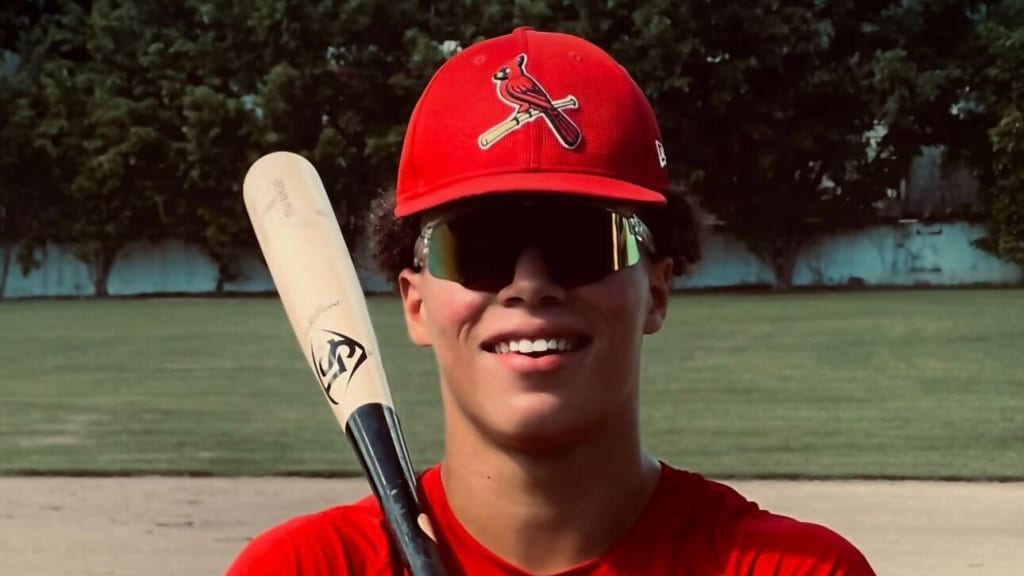
According to reporting from MLB.com, the Cardinals awarded Luna a signing bonus of $2.3 million—a substantial figure that underscores both the organization’s belief in his potential and its willingness to spend aggressively to secure premium talent.
For St. Louis, this move reflects more than a single-player investment. It signals a broader philosophy during a transitional phase: if the present is uncertain, then the future must be built deliberately. High-upside prospects like Luna become cornerstones of that vision, representing the possibility of a new competitive core emerging in the years ahead.
Physically, Luna already looks far more advanced than most players his age. At just 17 years old, he stands approximately 6-foot-2 and weighs around 195 pounds, with a build that scouts often associate with athletes several years older.
MORE: Phillies reportedly outbid Blue Jays for superstar infielder
He bats and throws right-handed, and his strength is immediately noticeable—not the kind that appears manufactured in a weight room, but the kind that seems naturally ingrained in his frame. Evaluators frequently note how easily power comes to him, even when he is not fully selling out for it at the plate.
There is also a poetic element to the timing of the signing. Thursday was not just the opening day of the international signing period—it was also Luna’s birthday. On the same day he turned 17, he officially committed to his professional baseball future by signing with the Cardinals.
For a teenager growing up in the Dominican Republic, where baseball often represents both a passion and a pathway to opportunity, the moment carries enormous personal significance. It marks the culmination of years of training and sacrifice, and the beginning of a journey that could eventually lead to the major leagues.
From a scouting perspective, Luna’s offensive profile is what truly sets him apart. Analysts describe his right-handed swing as explosive yet controlled, a combination that is difficult to teach and even harder to find in players so young.
With his strong lower half and broad shoulders, Luna generates impressive bat speed, allowing him to drive the ball with authority to all parts of the field. Rather than being limited to pull-side power, he shows the ability to let pitches travel and still impact the baseball, sending line drives and deep fly balls to right-center and straightaway center with regularity.

Scouting reports emphasize that this power does not come at the expense of approach. On the contrary, Luna is frequently praised for his advanced feel for hitting. He demonstrates an uncommon level of balance in the batter’s box, maintaining body control through his swing even against off-speed pitches. His hands stay quiet, his head remains steady, and he shows an understanding of how to adjust mid-swing—traits typically associated with far more experienced hitters.
Equally impressive is his discipline at the plate. Evaluators note that Luna possesses strong strike-zone awareness for a player in his age group. He is selective without being passive, able to recognize pitches he can drive while laying off those that fall outside his optimal hitting zones. This blend of patience and aggressiveness suggests a mature offensive mindset, one that could translate well as he climbs the minor league ladder and faces increasingly sophisticated pitching.
MORE: Red Sox Officially Acquire With Big-Time Power Potential After Ranger Suárez Deal
Some of the most optimistic voices within the scouting community believe Luna’s offensive ceiling may be even higher than what he currently shows. As he continues to face better competition and receives professional instruction, there is confidence that additional layers of his game will emerge.
Improved pitch recognition against advanced breaking balls, refined timing against higher-velocity fastballs, and greater consistency in translating raw power into game power are all areas where growth is anticipated. If those elements come together, Luna could develop into a middle-of-the-order threat capable of anchoring an offense.
While his bat is the primary attraction, Luna is not a one-dimensional prospect. Defensively, he is considered solid and reliable, particularly in the outfield. Though his throwing arm may not be elite in terms of sheer strength, it is praised for its accuracy and dependability. He makes the routine plays consistently and shows good instincts in tracking balls off the bat. His athleticism allows him to cover ground efficiently, and his strong build does not appear to hinder his mobility.
Scouts also point to his speed as a meaningful component of his overall profile. Despite his muscular frame, Luna runs well, displaying quick acceleration and above-average straight-line speed. This athleticism opens the door to additional value on the bases, and some evaluators project legitimate 20/20 potential—meaning the ability to hit 20 home runs and steal 20 bases in a season. Should his tools fully synchronize, there is even speculation that his production could exceed those benchmarks.

Interestingly, some scouting descriptions liken Luna’s physique to that of a football running back, a comparison that highlights both his power and explosiveness. It is a reminder that his athletic gifts extend beyond a single skill, encompassing strength, speed, coordination, and durability. These attributes not only enhance his upside but also suggest he may be better equipped to handle the physical demands of professional baseball over the long term.
For the Cardinals, the challenge lies in aligning Luna’s developmental timeline with their organizational trajectory. While the franchise undoubtedly hopes to return to postseason contention sooner rather than later, it also recognizes that international prospects often require patience. Players signed at 16 or 17 typically spend several years in the minor leagues, gradually adapting to the professional game, the daily grind of a long season, and the cultural adjustments that come with playing in a new country.
Yet there is a certain strategic appeal in this timing. If the Cardinals’ rebuild unfolds as planned, the major league roster could look significantly different by the time Luna approaches readiness. Veterans may be replaced by younger contributors, payroll flexibility could allow for targeted acquisitions, and a new core of players—developed internally or acquired through savvy trades—could be in place. In that scenario, Luna’s arrival would not be delayed or premature, but rather synchronized with a renewed window of competitiveness.
MORE: Red Sox officially confirmed another elite prospect addition
This is the quiet calculus behind international signings like Luna’s. They are not designed to solve immediate problems or plug short-term holes. Instead, they represent investments in possibility, in the belief that today’s teenager can become tomorrow’s impact player. For an organization navigating uncertain waters, such investments are both a necessity and a statement of intent.
In the end, the Cardinals’ decision to sign Emanuel Luna reflects a blend of hope, strategy, and calculated risk. Hope, that his tools and makeup translate into on-field success. Strategy, in recognizing that the international market is a vital avenue for acquiring elite talent during a rebuild. And risk, because all prospects—no matter how highly regarded—carry uncertainty.
Still, on the day Luna turned 17, the Cardinals made it clear they are willing to bet on the future. Whether that future unfolds exactly as envisioned remains to be seen. But if Luna develops as scouts believe he can, his journey from the Dominican Republic to professional baseball could intersect perfectly with St. Louis’s own path back to prominence, making him not just a promising prospect, but a symbol of the organization’s next chapter.


Be the first to comment