One of the last remaining priorities on the St. Louis Cardinals’ offseason agenda is securing a right-handed hitter capable of making a significant impact against left-handed pitching. It’s a need the organization has been aware of for some time, but it may not be resolved quickly. Instead, it feels like a situation that could linger well into the latter stages of the offseason before the Cardinals ultimately determine the right fit.
The delay is understandable when you consider the club’s current direction. St. Louis is not operating as an all-in contender at the moment; rather, the team is in a transitional phase, leaning toward a retool or rebuild. Because of that, the opportunity they’re offering isn’t necessarily the most attractive one on the market.
The role available for this right-handed bat would likely be a platoon assignment — someone who starts primarily against left-handed pitching and perhaps fills in at designated hitter or a corner outfield spot when the matchup calls for it. While that role has value, it’s not the kind of everyday, guaranteed opportunity that many established veterans are seeking.

For experienced players still on the free-agent market, especially those with long track records, pride and playing time matter. Many of them would prefer to sign somewhere they can either compete for a full-time job or join a clear postseason contender where their contributions could push a team over the top. A platoon role on a club in transition doesn’t always generate the same level of excitement. As a result, St. Louis may have to wait out the market rather than act quickly.
MORE: Giants provides absolutely stunning update regarding designated hitter ahead of spring training
Spring training is just around the corner, which adds another layer to the situation. As camps prepare to open in the coming weeks, a number of free agents are likely weighing their options carefully. Some may choose patience over urgency, holding off on signing in hopes that injuries elsewhere in the league create more appealing opportunities.
Every spring, unexpected setbacks during workouts or early exhibition games open doors for veterans who were previously overlooked. A player considering the Cardinals’ offer might decide it’s wiser to wait and see if a starting job becomes available with a contending club rather than commit now to a limited role in St. Louis.
There’s also the possibility that a similar platoon opportunity could emerge with a team projected to compete for a division title or a wild card spot. For many players at this stage of their careers, the chance to chase a championship outweighs nearly every other factor. If that kind of scenario develops, the Cardinals could find themselves losing out to a more competitive organization.
Meanwhile, movement around the league continues to shape the landscape. On Monday, the Pittsburgh Pirates finalized a one-year contract with former Cardinals outfielder Marcell Ozuna. That signing appears to close the door on a potential reunion between Pittsburgh and franchise icon Andrew McCutchen for the 2026 season. Ozuna’s arrival likely fills the offensive veteran role the Pirates might have otherwise reserved for McCutchen.

That development could have ripple effects for St. Louis. McCutchen, who remains eager to continue his playing career, suddenly looks like a logical target for the Cardinals. Even at this stage of his career, McCutchen has shown he can still provide value, particularly against left-handed pitching. His experience, leadership, and professional approach would also offer intangible benefits in a clubhouse that is balancing youth and transition.
MORE: White Sox reunite with pitcher dealt in 3-way trade with Dodgers, Cardinals
From a baseball standpoint, the fit makes sense. McCutchen has long demonstrated an ability to handle left-handed pitching, and in a platoon situation, he could be deployed strategically to maximize his strengths. He wouldn’t be asked to carry the lineup or play every day, but rather to serve as a complementary piece — someone who can lengthen the batting order in favorable matchups and mentor younger hitters along the way.
The key question, of course, is mutual interest. While St. Louis may view McCutchen as an ideal solution, it ultimately comes down to whether he would be willing to join the Cardinals. There are layers to that consideration. McCutchen spent the prime of his career with the Pirates and remains closely associated with that franchise. Signing with a division rival would be a notable shift, though not unprecedented in professional sports. Players often prioritize opportunity and fit over past affiliations, particularly later in their careers.
Additionally, McCutchen would need to be comfortable with the likely role awaiting him. If he’s seeking regular at-bats or hoping for one last run as an everyday starter, St. Louis may not align with those goals. However, if his priority is to continue playing, contribute meaningfully, and perhaps take on a veteran leadership role, the Cardinals could present a compelling option.
For St. Louis, patience may be the best approach. The market for right-handed bats who excel against left-handed pitching tends to evolve slowly, especially when those players are weighing limited roles. The Cardinals don’t necessarily need to rush into a decision; instead, they can monitor how the market unfolds, reassess as injuries occur, and stay flexible.
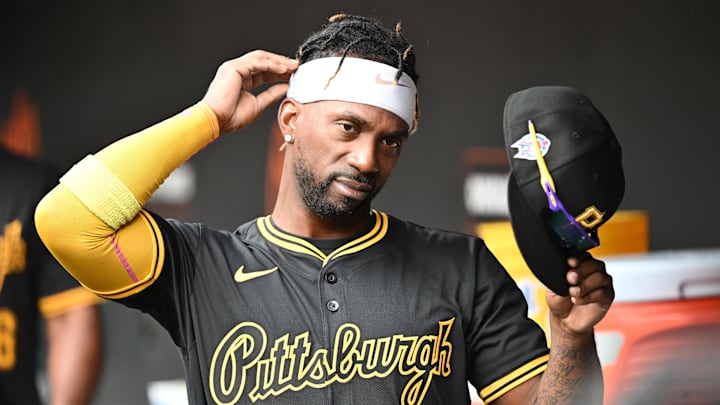
In the end, whether it’s McCutchen or another veteran still searching for the right fit, the Cardinals’ final offseason move is likely to come down to timing and alignment. The need is clear — a dependable right-handed hitter who can punish left-handed pitching — but finding the right personality, contract structure, and expectations match may take a bit longer. Until then, it remains a waiting game, with St. Louis keeping its options open as the start of spring training approaches.
Andrew McCutchen is a perfect fit for the Cardinals’ right-handed hitting outfielder need
Andrew McCutchen’s 2025 season with the Pittsburgh Pirates could best be described as serviceable but unspectacular. Over the course of 135 games, he produced a .239/.333/.367 slash line, launching 13 home runs and driving in 57 runs. Those numbers don’t jump off the page, especially for a player who once dominated the National League and claimed MVP honors.

At this stage of his career, McCutchen is no longer the kind of player who can be penciled into the lineup every single day without question. The consistency and all-around impact that once defined his prime years have understandably tapered off. However, that doesn’t mean he lacks value. In fact, when you look a little deeper—particularly at how he performed against left-handed pitching—you can see why a team like the St. Louis Cardinals might still have legitimate interest.
MORE: Understand Tigers’ first baseman signs minor-league deal with Cardinals
Against southpaws in 2025, McCutchen posted a 104 wRC+, meaning he was slightly above league average in that specific split. While that figure isn’t elite, it demonstrates that he remains capable of contributing meaningfully in a specialized role. For a Cardinals club that could use a reliable right-handed bat to balance its lineup, especially one that can do damage against left-handers, McCutchen checks an important box.
St. Louis doesn’t necessarily need him to be an everyday fixture. Instead, they need someone who can step into favorable matchups, lengthen the lineup, and provide professional at-bats in key situations. In that context, McCutchen’s skill set becomes much more appealing.
Beyond the numbers, though, McCutchen would bring far more to the Cardinals than just platoon production. His reputation around Major League Baseball is sterling. He’s widely regarded as a high-character individual, a respected clubhouse presence, and a consummate professional.
Those traits matter—particularly for a team transitioning into a new era centered on youth. The Cardinals’ roster is trending younger, and while that youthful energy is exciting, it can also create a leadership void. Veteran guidance becomes increasingly valuable when a team is leaning heavily on players who are still learning how to navigate the demands of a full big-league season.

McCutchen’s résumé speaks for itself. As a former National League MVP, multi-time All-Star, and one of the defining players of his generation, he has experienced nearly every situation the sport can present. He has played on playoff contenders with legitimate championship aspirations.
MORE: Mets-Pirates Blockbuster Trade Idea Offloads 17-Home Run to Pittsburgh With Really Crowded Infielders
He has also been part of rebuilding efforts where patience and development were emphasized over immediate results. That breadth of experience is not something that can be easily replicated or taught. Younger players benefit from seeing how someone with McCutchen’s background prepares daily, handles adversity, and carries himself both on and off the field.
It’s particularly notable that Lars Nootbaar is currently the oldest position player on the Cardinals’ roster. That fact underscores just how young this group truly is. While youth can be an asset—bringing speed, athleticism, and upside—it also often comes with inconsistency. A veteran like McCutchen would help steady the ship. He wouldn’t need to dominate statistically to justify his presence. Simply offering mentorship, perspective, and accountability in the clubhouse could have a ripple effect throughout the roster.
The 2026 season is widely viewed as a year focused on development and growth for St. Louis. The organization appears committed to giving its young core meaningful opportunities to establish themselves. However, embracing youth doesn’t mean excluding veterans entirely. In fact, having at least one experienced player who understands the rhythms of a long season can be incredibly beneficial. McCutchen could serve as a bridge between the Cardinals’ past traditions of sustained success and their future ambitions built around emerging talent.
Of course, clarity about roles would be essential. McCutchen and the Cardinals would need to be aligned regarding expectations. He is no longer an everyday outfielder capable of playing 150 games while hitting in the heart of the order.

But if both sides acknowledge that his role would be somewhat limited—focused on favorable matchups, occasional starts, pinch-hitting appearances, and clubhouse leadership—then the partnership could make a great deal of sense. In that capacity, McCutchen could provide an offensive spark when needed while also reinforcing the professional culture St. Louis has long prided itself on maintaining.
There’s also a sentimental and narrative element that adds intrigue to the idea. Victor Scott II, one of the Cardinals’ promising young players, grew up idolizing McCutchen. As a fan of both the Pirates and Braves during his childhood, Scott admired McCutchen’s style of play and presence. Bringing in a player who once inspired one of your own prospects could create a unique dynamic.
MORE: Phillies Blockbuster Trade Idea Sends Nick Castellanos To Rockies
Imagine Scott sharing a clubhouse with someone he once watched on television, studied, and tried to emulate. That kind of connection can be motivating and even transformative for a young athlete. It reinforces the cyclical nature of the game—today’s stars becoming tomorrow’s mentors.
The Cardinals themselves have expressed enthusiasm about Scott’s offseason progress. They appear genuinely excited about his development and potential impact. Adding McCutchen to the mix could further accelerate that growth, not necessarily through direct instruction alone, but through example. Watching how a seasoned veteran prepares for games, handles slumps, and adjusts to evolving roles can be invaluable for a young player still carving out his identity at the major-league level.
Admittedly, seeing McCutchen in a Cardinals uniform would feel unusual. He spent the prime of his career as a Pirate, often serving as one of the central figures in the rivalry between Pittsburgh and St. Louis. Cardinals fans remember him as a formidable opponent, someone who frequently stood in their way during divisional battles. However, recent history shows that St. Louis has not hesitated to welcome former rivals into the fold.
Willson Contreras, once a key member of the Chicago Cubs, now plays a significant role for the Cardinals. Jon Lester, another prominent Cub, also donned the St. Louis uniform late in his career. José Quintana made the same transition, and interestingly, he arrived via a trade with the Pirates at the 2022 deadline. These moves demonstrate that organizational lines blur over time. What once felt like an unthinkable crossover can quickly become routine in modern baseball.

Given that precedent, the idea of McCutchen switching sides in the NL Central isn’t as far-fetched as it might have seemed a decade ago. Teams prioritize fit and value over past allegiances. If McCutchen can help St. Louis improve in specific areas—particularly against left-handed pitching—then prior rivalries become secondary.
That said, the Cardinals do have internal options to consider. They could choose to experiment with positional flexibility, perhaps transitioning infielders like Thomas Saggese or Jose Fermin into more regular outfield roles. They might also lean on players signed to minor-league deals, giving them opportunities to seize roster spots during spring training. This approach would align with a youth-focused strategy and preserve financial flexibility.
Still, there’s something to be said for adding one more established veteran bat to complement the younger core. Even if his statistical contributions are modest, the intangible benefits could outweigh the raw numbers. A clubhouse comprised almost entirely of players in their early- to mid-20s might benefit immensely from having a seasoned professional who has navigated both personal highs and team-wide challenges.
MORE: Dodgers blockbuster trade sends Roki Sasaki to Giants for $90 million ace
McCutchen’s career arc also provides a blueprint for longevity and adaptation. He has evolved from a dynamic five-tool center fielder into a more selective, situational contributor. That transformation requires humility and self-awareness—traits that younger players would do well to observe. Accepting a reduced role while continuing to prepare with the same intensity speaks volumes about character.
Financially, a short-term, low-risk contract would likely be all that’s required. The Cardinals wouldn’t be committing significant resources or blocking top prospects long-term. Instead, they’d be making a calculated move to supplement their roster in a targeted way.
Ultimately, while the numbers from 2025 suggest McCutchen is no longer a middle-of-the-order force, they don’t tell the entire story. His continued effectiveness against left-handed pitching fills a clear need. His leadership and experience address a subtle but important roster gap. His presence could positively influence young players like Victor Scott II and others trying to establish themselves in the big leagues.
For a 2026 season centered on youth and development, incorporating a respected veteran like Andrew McCutchen could provide balance. If expectations are managed appropriately and roles are clearly defined, the fit makes sense on multiple levels. The Cardinals may have other avenues to explore, and they could ultimately decide to rely on internal options. But if they do choose to add one more seasoned hitter to the mix, McCutchen stands out as a compelling candidate—one who could deliver value both on the field and within the fabric of the organization.


Be the first to comment