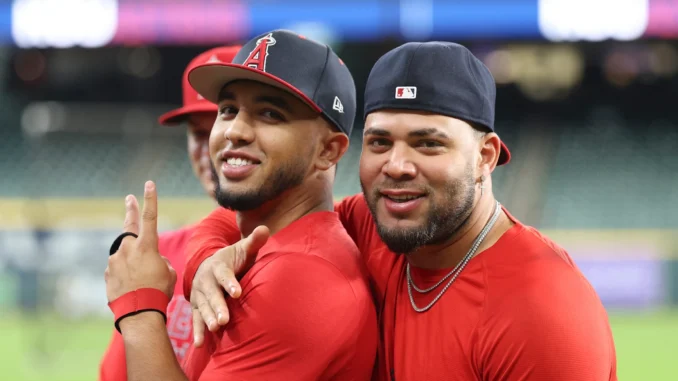
The Los Angeles Angels made a notable move in the offseason by acquiring outfielder from the Tampa Bay Rays, signaling their clear desire to strengthen their roster for the 2026 season. This addition reflects the team’s ongoing efforts to improve offensively and defensively, adding a player with experience and potential to contribute immediately.
However, despite this high-profile acquisition, the Angels are still confronted with a significant uncertainty regarding one of the most crucial positions on the field: center field. Determining who will man this spot consistently remains an unresolved challenge for the organization.
Los Angeles has assembled a strong group of outfielders, particularly in the corners. Jo Adell, once considered one of the franchise’s top prospects, continues to develop and offers both power and defensive versatility. Mike Trout, the face of the franchise for over a decade, remains a dominant force in left field when healthy, providing both offensive production and leadership.
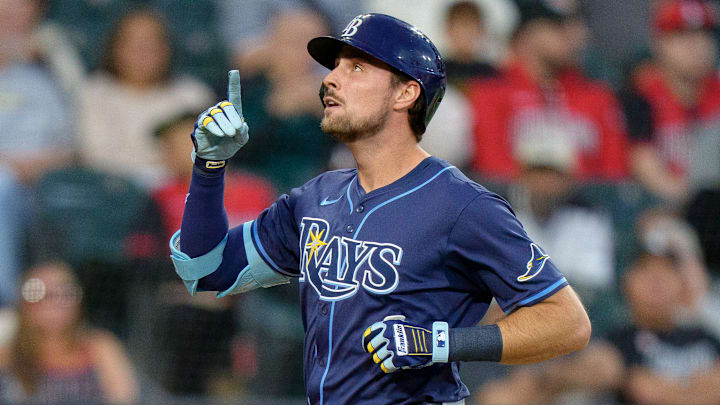
Jorge Soler adds additional firepower and a veteran presence in the lineup. And now, with the addition of Josh Lowe, the Angels have yet another option to bolster their outfield depth. Collectively, this group gives the Angels a wealth of talent along the lines, suggesting they could be formidable defensively and offensively in the corners.
Yet, even with all these pieces in place, the center field position remains unsettled. The Angels have yet to identify a true everyday player who can reliably patrol the vast expanse of center field, a role that requires both defensive skill and consistent durability.
MORE: White Sox To Sign Entertaining Phillies’ Outfielder
This is a notable concern because center field is not just another outfield position—it demands athleticism, range, and the ability to cover significant ground, often serving as the anchor for the entire outfield. Without a clear answer, the team faces potential instability in a position that can impact both runs saved and overall team defense.
The offseason moves, including the acquisition of Lowe, demonstrate that the Angels are committed to building a competitive team, but the lack of a definitive center fielder underscores a critical gap. While corner outfielders like Adell, Trout, Soler, and Lowe can offer flexibility and production, none of them fully solves the question of who can handle center field on a daily basis. This uncertainty could influence the team’s strategies, from defensive alignments to roster construction, and may even affect future acquisitions or trades as the Angels continue to search for a long-term solution.

In short, while the Angels have improved their overall outfield options and added depth with Josh Lowe, the center field position remains a pressing question heading into 2026. Corner outfield talent abounds, but the team still lacks a clear, everyday presence in center field, leaving a key spot unresolved as the organization seeks to balance talent, defense, and long-term stability. Until they settle on a primary center fielder, this area will remain one of the team’s most pressing challenges.
Angels need to figure out who will play center field after Lowe acquisition
The Los Angeles Angels are currently facing a significant conundrum in their outfield, particularly when it comes to the center field position. With the recent addition of Brandon Lowe, questions naturally arise about how the team will configure its defensive alignment, especially since Lowe is not inherently a natural center fielder.
Over the course of his major league career, Lowe has made just 25 appearances in center field, a relatively small sample that makes it difficult to confidently assess his capabilities in that position. Traditionally, Lowe has been utilized in other outfield spots, and while he has some experience in right field, he has never been particularly distinguished there defensively.
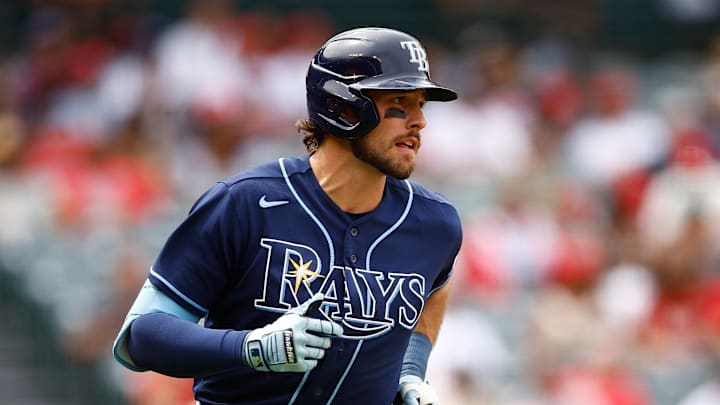
This raises legitimate concerns about whether he can hold his own in center field, a position that demands exceptional range, quick reaction times, and the ability to cover vast amounts of territory with consistency. The Angels, however, might find themselves in a position where they have limited alternatives unless they actively pursue another move in the offseason, whether that involves trading for a center fielder or signing a free agent.
MORE: Cardinals front office confirms to trade fan favorite Lars Nootbaar
The Angels’ front office, led by general manager Perry Minasian, has acknowledged the potential challenges of the center field vacancy. Minasian has indicated that other players, such as Jo Adell and Mike Trout, could also serve as options in center field. However, he has been clear that the ultimate decisions regarding defensive alignments will be left to the team’s incoming manager, Kurt Suzuki.
While it is true that both Trout and Adell have the athleticism to handle center field in a pinch, neither of them represents a long-term solution. Trout, of course, is widely regarded as one of the greatest players of his generation, and he once possessed the elite skills of a top-tier center fielder. In his earlier years, his range, speed, and instincts in center field were exceptional, making him a defensive asset as well as an offensive powerhouse. Nevertheless, Trout’s physical limitations have evolved over time due to injuries and age, reducing his mobility and overall defensive reliability.
Consequently, while he could theoretically patrol center field, relying on him to consistently cover the position for an entire season might be risky. Similarly, Jo Adell has shown flashes of defensive excellence and raw athletic ability, but he, too, is not yet a proven, everyday solution in center. His inconsistency at the plate and in the field makes it difficult to project him as a reliable anchor in the outfield.

Beyond the major league roster, the Angels do possess some options in the minor leagues, though these come with their own caveats. One such player is Wade Meckler, a speedy and agile outfielder recently acquired from the San Francisco Giants.
Meckler embodies many of the qualities that teams look for in a traditional center fielder: excellent range, solid instincts, and the ability to cover ground quickly in the outfield. From a theoretical standpoint, he represents an attractive solution to the Angels’ center field problem. However, Meckler’s lack of major league experience introduces a level of uncertainty. His exposure at the highest level has been extremely limited, consisting of only a brief cup of coffee with the Giants back in 2023.
MORE: Phillies confirmed to sign veteran Max Scherzer ‘upgrade over Walker’
Since then, he has yet to log additional major league innings, meaning the Angels would be relying on a player whose ability to handle the rigors of everyday MLB play is largely untested. While his speed and defensive instincts are promising, questions remain about his consistency, endurance, and capacity to handle the mental and physical demands of regular play in center field.
Given the limitations of both the current roster and the minor league alternatives, the Angels might need to consider a more creative, unconventional approach to managing their outfield. One possibility is employing a “center fielder by committee” strategy. Under this model, the team could rotate players such as Lowe, Adell, and Trout in center field depending on matchups, rest needs, and overall performance.
This would allow the Angels to distribute defensive responsibility while potentially identifying which player is most comfortable or effective in the role. The strategy could also involve some degree of experimentation with corner outfield spots, effectively creating a dynamic system in which players shift positions based on team needs or individual strengths.
While this approach is less than ideal, it might be the most pragmatic solution if the team does not acquire a dedicated, proven center fielder. It offers flexibility and allows the front office to assess player performance in live game situations, which could be valuable for planning longer-term strategies in future seasons.

Adding to this complex equation is prospect Nelson Rada, who presents another defensive option for the Angels. Rada has demonstrated versatility and competence in the outfield, suggesting that he could contribute defensively if needed. However, the uncertainty surrounding his bat complicates matters. While he may provide defensive stability, his offensive output may not yet be sufficient to justify consistent major league play.
This underscores a broader challenge facing the Angels: finding a balance between defensive reliability in center field and maintaining offensive production. Without a strong, proven center fielder, the team risks compromising either their defensive coverage or their ability to generate runs, making strategic roster decisions particularly delicate.
MORE: Braves To Trade Sean Murphy To Pirates For $77 Star, To Solidify Both Teams
The current situation illustrates a broader point about roster construction and strategic planning in Major League Baseball. Ideally, teams prefer to have a designated, everyday center fielder—someone who is both defensively adept and capable of contributing consistently at the plate.
A reliable center fielder anchors the outfield, allowing corner outfielders to focus on their respective roles without compensating for coverage gaps. The absence of such a player forces teams to improvise, whether through rotation, minor league call-ups, or unconventional defensive alignments.
In the Angels’ case, the recent acquisition of Lowe adds depth and talent to the outfield overall but does not fully resolve the center field dilemma. Lowe’s skill set, while valuable, is more aligned with corner outfield play, meaning that the team must still navigate a challenging decision-making landscape when it comes to optimal defensive placement.
This scenario is further complicated by the reality of free agency. While the Angels could theoretically address their center field concerns by signing a player like Harrison Bader—an outfielder known for his defensive prowess and speed—the constraints of budget, roster composition, and competitive considerations may limit their options.
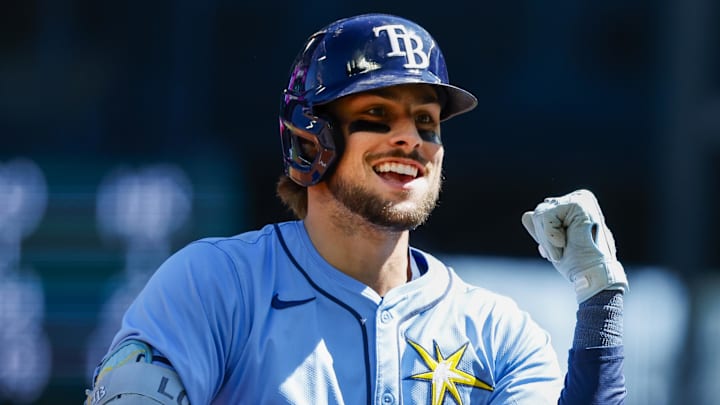
Free agent signings are rarely simple, involving negotiations, financial considerations, and the potential displacement of other players. Thus, the Angels’ approach will likely require a blend of internal solutions, creative experimentation, and selective acquisition to ensure that the team is not left vulnerable in a critical defensive position. The challenge lies not just in filling the center field spot but in doing so in a way that preserves both team cohesion and overall competitive balance.
MORE: Mets send Brett Baty to the Mariners for switch-pitcher in 3-player blockbuster deal
Ultimately, the Angels’ center field situation exemplifies the nuanced, multifaceted nature of baseball roster management. It is not simply a matter of plugging a player into a position; it involves evaluating defensive aptitude, offensive contribution, health and durability, and even psychological comfort in the role. Brandon Lowe’s arrival brings potential benefits but does not eliminate uncertainty.
Jo Adell and Mike Trout offer additional options, yet neither represents a long-term, guaranteed solution. Meanwhile, prospects like Wade Meckler and Nelson Rada bring defensive promise but limited experience or offensive uncertainty. In the absence of an obvious, elite center fielder, the Angels are left with a series of imperfect choices, each with trade-offs and potential risks.
The coming months, particularly under the guidance of manager Kurt Suzuki, will likely involve experimentation, careful evaluation, and tactical decision-making as the team seeks to maximize both its defensive coverage and overall roster efficiency.
The scenario also underscores the importance of flexibility and adaptability in modern baseball. Teams are increasingly required to make real-time decisions based on evolving player performance, injuries, and strategic needs. A rigid approach—such as committing a single, untested player to center field for an entire season—could backfire, leading to defensive lapses, reduced team performance, and lost games.
Conversely, a more fluid, rotational approach could allow the Angels to identify hidden strengths, distribute workload, and adapt to unforeseen circumstances, even if it lacks the elegance and stability of a traditional solution. By embracing creativity, leveraging minor league talent judiciously, and carefully balancing offensive and defensive considerations, the Angels can mitigate the risks inherent in their center field dilemma.
In conclusion, while the acquisition of Brandon Lowe bolsters the Angels’ outfield depth, the center field position remains a challenging puzzle. Lowe’s limited experience in center field, coupled with his historical defensive limitations in right field, makes him an imperfect choice for the role.
Jo Adell and Mike Trout offer supplementary options, though neither can provide a full-season solution without compromise. Minor league prospects like Wade Meckler and Nelson Rada present additional possibilities, yet their inexperience or offensive uncertainties temper their immediate value.
As a result, the Angels may need to adopt an inventive approach—such as rotating players in a “center fielder by committee” model—to navigate this challenge effectively. Unless the team signs a proven defensive center fielder in free agency, they will need to rely on flexibility, experimentation, and strategic evaluation to ensure that the outfield is both productive and reliable.
While this situation is far from ideal, it reflects the complex, dynamic nature of roster management in Major League Baseball and highlights the need for creativity and adaptability when faced with positional uncertainty. Ultimately, the Angels’ handling of center field in the upcoming season will be a testament to their ability to balance talent, experience, and strategic ingenuity in pursuit of competitive success.


Be the first to comment