
The Arizona Diamondbacks have quietly added another name to their pitching depth chart, agreeing to a minor league contract with right-hander Jonathan Loáisiga, according to reporting from ESPN insider Jorge Castillo.
The agreement places Loáisiga in big league camp with Arizona during spring training, giving both sides a low-risk opportunity to see whether a once-dominant arm can rediscover its form and stay healthy long enough to contribute meaningfully at the major league level.
Loáisiga is represented by the Ballengee Group, and the structure of the deal reflects where he currently stands in his career: talented, experienced, and still relatively young at 31, but coming off multiple seasons disrupted by injuries.
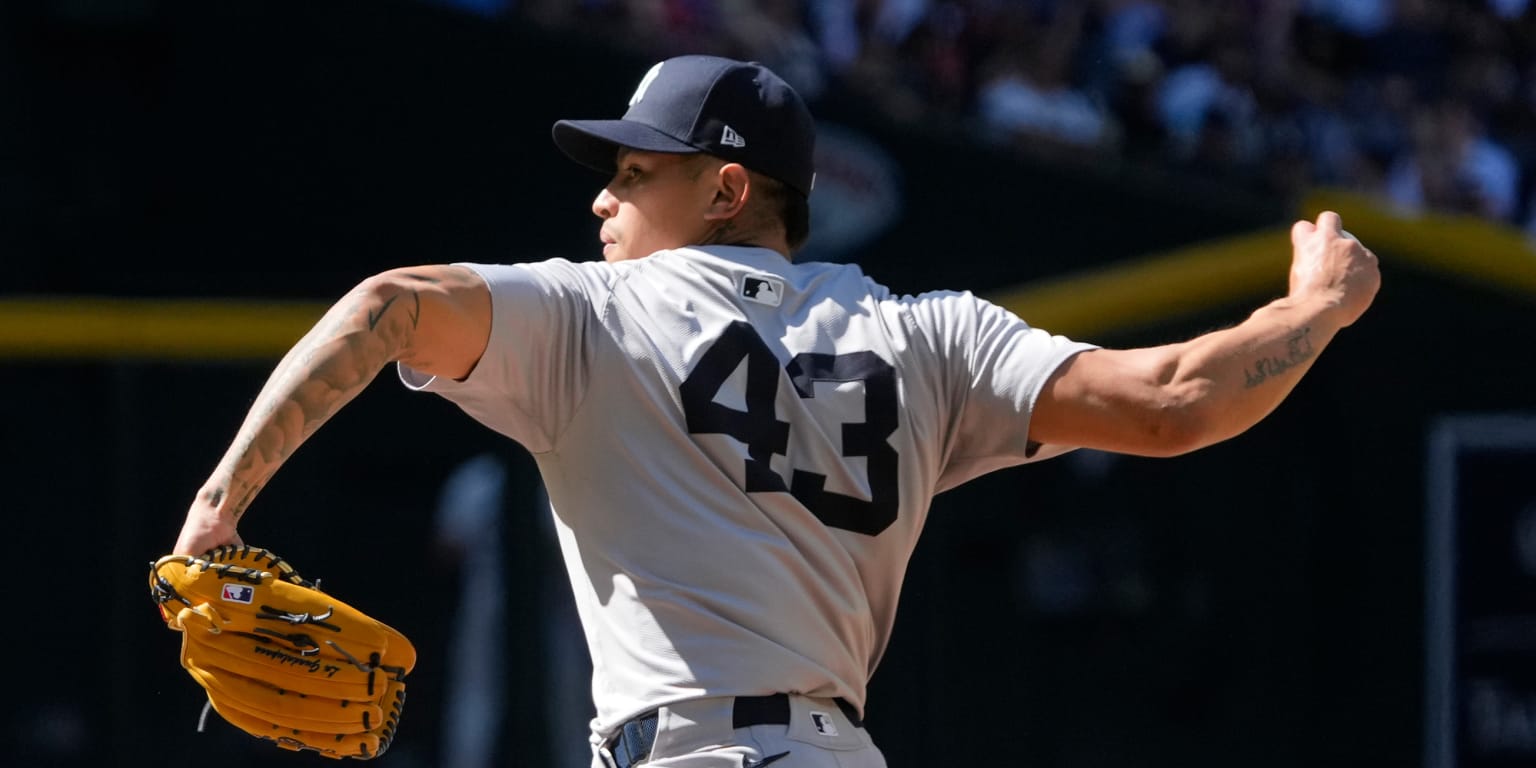
For the Diamondbacks, the move is emblematic of a broader strategy—seeking upside plays that do not immediately consume roster spots or significant payroll space while still addressing a bullpen that struggled mightily just a season ago.
A Career Defined by Electric Stuff—and Physical Setbacks
At his best, Jonathan Loáisiga has looked like one of the most overpowering relievers in baseball. His peak came during the 2021 season with the New York Yankees, when he emerged as a central figure in their bullpen. That year, Loáisiga logged 70 2/3 innings and posted a sparkling 2.17 ERA, numbers that placed him among the most effective high-leverage relievers in the game.
MORE: Braves official transactions land superstar righty
What made Loáisiga so dangerous during that stretch was not just his results, but the manner in which he achieved them. He regularly touched 98 miles per hour with both his four-seam fastball and his sinker, pairing elite velocity with heavy movement.
Hitters struggled to square him up, and when they did put the ball in play, it was often pounded into the ground. His 60.9% ground-ball rate that season underscored how difficult it was to elevate anything with authority against him.

Beyond the fastball variants, Loáisiga mixed in a deep arsenal that included a cutter, slider, curveball, and changeup. The diversity of his pitch mix allowed him to attack hitters in multiple ways and remain effective against both right- and left-handed batters.
MORE: Rangers Focused On Pitching, Why This is the Real Priority
From a command standpoint, 2021 represented the most refined version of Loáisiga: he struck out 24.4% of opposing hitters while limiting walks to just 5.7%, an impressive combination that helped him thrive in late-inning roles.
That season also saw him collect five saves and ten holds, reflecting the Yankees’ trust in him during high-leverage moments. For a time, he appeared to be a long-term bullpen cornerstone—an arm capable of bridging the gap to the ninth inning or even closing when needed.
Injuries Begin to Chip Away
Unfortunately, the seasons that followed were marked less by dominance and more by inconsistency and health concerns. In 2022, Loáisiga missed roughly six weeks due to inflammation in his throwing shoulder, an early warning sign of the durability issues that would soon define this phase of his career.

While he returned to the mound and finished the year with 48 innings pitched, his effectiveness slipped. His ERA rose to 4.13, and the underlying indicators painted a picture of diminished sharpness.
Although his ground-ball rate remained relatively stable, his ability to miss bats declined noticeably. His strikeout rate dropped to 18.2%, and his walk rate climbed to 9.4%, suggesting that his command and overall stuff were no longer quite at the same level. These changes, while not catastrophic on their own, hinted at a pitcher battling both physical limitations and mechanical adjustments.
MORE: Mets-Angels Blockbuster Trade Proposal Lands 37-Home Run Outfielder
The situation worsened in 2023, when persistent elbow issues limited Loáisiga to just 17 2/3 innings for the entire season. Attempts to manage the problem conservatively ultimately proved insufficient. In April 2024, he underwent surgery on his ulnar collateral ligament, a procedure that immediately cast doubt on his short-term availability and long-term outlook.
A Difficult Return in 2025
Loáisiga spent the early portion of the 2025 season on the injured list as he worked his way back from UCL surgery. When he was finally activated in mid-May, the results were mixed. Over 29 2/3 innings, he posted a 4.25 ERA—respectable given the circumstances, but far from the dominant force he once was.
The peripheral numbers told a similar story. His strikeout rate sat at 18.5%, his walk rate at 7.4%, and his ground-ball rate dipped to 50.5%. Perhaps most concerning was the noticeable decline in velocity. His average fastball sat below 97 miles per hour, a meaningful drop for a pitcher whose effectiveness had long been tied to elite speed and power.

As if the comeback itself weren’t challenging enough, Loáisiga’s season was again interrupted in August when he landed on the injured list with back tightness. While rehabbing that issue, he suffered a lat strain, effectively ending his year and preventing any late-season momentum from building.
Given the accumulation of injuries and the uncertainty surrounding his durability, the Yankees ultimately declined a $5 million club option for his services in 2026, sending him back into free agency.
Arizona’s Perspective: Low Risk, Potential Reward
From the Diamondbacks’ standpoint, the decision to bring in Loáisiga on a minor league deal is a calculated gamble. Arizona’s bullpen was a glaring weakness in 2025, finishing the season with a collective ERA of 4.82—better than only three teams across the majors. That performance came despite preseason expectations that the relief corps would be a strength.
MORE: Cardinals confirmed another elite prospect addition
Those expectations were largely built around arms like A.J. Puk and Justin Martínez, both of whom were expected to anchor the bullpen. Instead, the plan unraveled early, as both pitchers required UCL surgeries during the first half of the season. The loss of those two arms forced Arizona to scramble for innings and exposed a lack of reliable depth behind them.

With the bullpen in such rough shape, upgrading for 2026 is clearly a priority—but it is also complicated by financial realities. The Diamondbacks are widely expected to operate with a reduced payroll, and resources may need to be allocated toward strengthening the rotation and outfield as well. That context makes splashy free-agent signings in the bullpen less likely.
This is where a deal like Loáisiga’s becomes attractive. On a minor league contract, he does not immediately occupy a spot on the 40-man roster, nor does he command a guaranteed salary that would strain the budget. Instead, Arizona gains the right to evaluate him up close during spring training, assess his health and velocity, and determine whether he can realistically contribute at the major league level.
If Loáisiga shows signs of his old form—improved velocity, sharper command, and the ability to handle regular workloads—he could earn his way onto the roster and provide meaningful innings in a bullpen that desperately needs stability. Even if he ultimately falls short, the financial and roster risk to the organization remains minimal.
Looking Ahead to 2026
Both sides enter this arrangement with aligned incentives. For Loáisiga, the priority is clear: stay healthy and prove that he can still be an effective major league reliever. At 31, he is not yet at an age where a comeback would be unprecedented, especially given the flashes he has shown even after surgery. A strong spring or early-season performance could put him back on the radar as a valuable bullpen piece, whether in Arizona or elsewhere.

For the Diamondbacks, the hope is that Loáisiga represents one of several under-the-radar additions that collectively raise the floor—and possibly the ceiling—of their relief corps. According to John Gambadoro of Arizona Sports, the club is expected to make additional bullpen moves in the coming days, suggesting that Loáisiga’s signing is part of a broader effort rather than a standalone solution.
MORE: Diamondbacks officially solidify bullpen with the signing of superstar righty
If Loáisiga eventually earns a call-up, the financial commitment is expected to be modest, though the exact salary structure has not been disclosed. That uncertainty only reinforces the nature of the deal: flexible, low-cost, and heavily dependent on performance and health.
In the end, the signing encapsulates the reality of modern roster construction for mid-market teams. Rather than betting heavily on one expensive reliever, the Diamondbacks are spreading their risk across multiple upside plays, hoping that one or two will break right. Jonathan Loáisiga, with his history of dominance and his ongoing battle with injuries, fits squarely into that approach—a reminder that even the most uncertain bets can pay off if timing, health, and opportunity finally align.

Be the first to comment